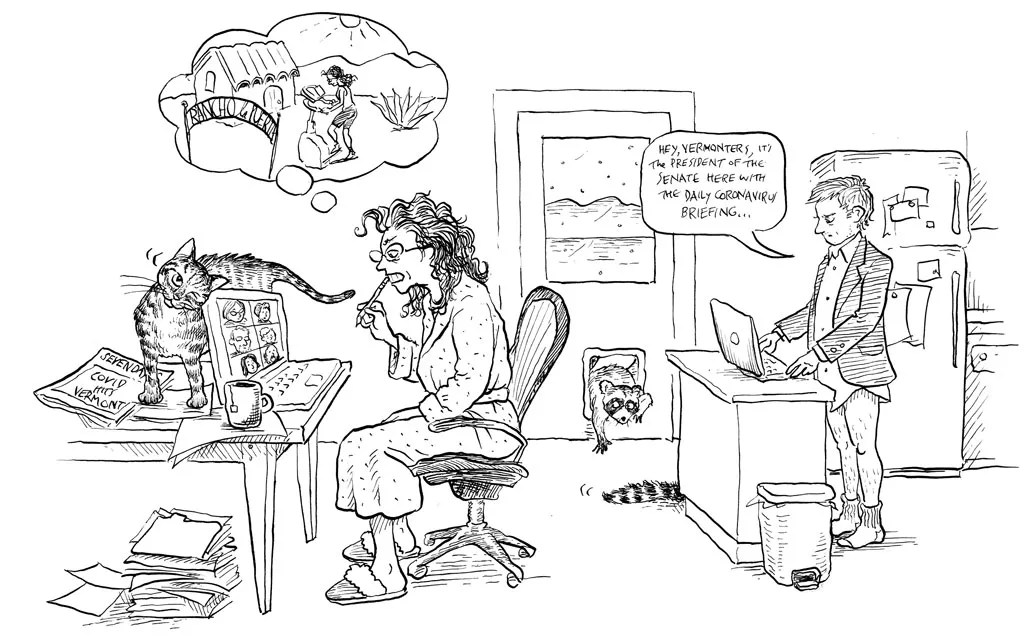
I’m thinking about the coronavirus pandemic for two reasons. No. 1: Four years ago this week, it shut down life as we knew it. No. 2: I’m preparing for an interview with the Vermont Historical Society, which is collecting oral testimonies in an effort to document how the public health crisis played out in this state.
My questioner, seasoned journalist Mark Johnson, has already talked to a lot of people. He’s warned me: It’s surprisingly hard for individual narrators to accurately recall the collective trauma we shared.
But I have a memory enhancer: my weekly “From the Publisher” columns. I wrote the first one, “A Letter to Our Readers,” on March 18, 2020, to acknowledge the pandemic and the mortal threat it posed, including to Seven Days. The paper relies almost entirely on income from advertising to fund our news gathering, and that revenue dried up virtually overnight. With no way to predict the length of the resulting economic shutdown, or whether Seven Days could survive it, I continued to document the experience in real time.
One column captured the early days, when people still believed the virus spread on surfaces and so were too scared to pick up our newspaper. Another, three days after I unceremoniously turned 60, noted: “In truth, nobody could have imagined how we’re all living today: hunkered down in our respective safe houses, socializing on computer screens that look like the old ‘Hollywood Squares’ game show, venturing out to score supplies like masked survivalists.”
In April 2020, I learned my mother was dying of cancer and spent much of the next month working from her room at Burlington’s Converse Home, an assisted-living facility that was on lockdown. They let me in — against the usual COVID-19 protocols — because my mother was terminal, but I witnessed firsthand the logistical challenges and questionable trade-offs of isolating vulnerable seniors.
I wrote about running Seven Days through layoffs, loans, canceling and creating products, and the unexpected surprise that readers cared enough about the paper to support it financially. I chronicled what other businesses were going through — the hurdles restaurants had to clear, dark theaters, the labor shortage, changing mask mandates. The chaos of the vaccine rollout, long waits to get jabbed or to see a doctor, fear of contagion, shame.
I didn’t actually catch the bug until January 2022; by then, I’d written more than 80 columns prompted by it.
One was a history lesson on the last time such a deadly disease swept the globe. The 1918 pandemic killed 50 million worldwide, 675,000 of whom were Americans. Surprisingly, though, public health officials couldn’t shed much light on the “Spanish flu” — so named, they say, because Spain was the sole country to publicly record its toll.
Countries still involved in World War I discouraged news coverage of the pandemic. The U.S. went along with the media blackout. Mention of the deadly virus was also rare in literature and other art of the time. A May 14, 2020, New York Times article headlined “Why Are There Almost No Memorials to the Flu of 1918?” suggested: “The mass amnesia helps explain the lack of preparation for the Covid-19 crisis.”
In that column on December 2, 2020, I had the audacity to assert: “Vermonters won’t soon forget this global pandemic.”
Guess I was wrong. I couldn’t have imagined that four years later, we’d be so tired of talking about it that we’d feel a powerful urge to forget and move on.
This is how the brain heals and protects itself. Reading over my columns, reliving the fear and uncertainty we felt at the time, brought me to tears.
I’m not eager to hold on to that existential dread. But I’m glad I found words to capture it.


This article appears in Mar 13-19, 2024.

Got something to say?
Send a letter to the editor and we'll publish your feedback in print!