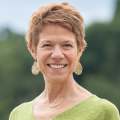
This “Life Stories” profile is part of a collection of articles remembering Vermonters who died in 2025.
Shanda Williams’ commitment to dismantling racism and healing its resulting trauma had driven her to speak up, to organize study groups, to sue the State of Vermont and to start an annual finance symposium for women. By summer 2023, she was prepared to walk across hot coals.
Shanda organized a July event called Stomp Out Racism, which centered on firewalking. The benefit was intended to raise awareness and money for the Vermont Kindness Project, a Montpelier enterprise she cofounded to help heal intergenerational trauma. Firewalking and conquering racism share a common theme, said Ginger Cloud, the Barre counselor and firewalk instructor who was to teach that day. Walking barefoot over embers, she said, is about listening to the fire, breaking boundaries and doing the unthinkable.
“There’s elements of overcoming,” Cloud said. “We’re taught from a very young age, most of us, to fear fire, and so there’s this coming into [a] relationship with something we’ve been told to fear.”
Shanda intended to shed her shoes and participate, said Abbi Jaffe, who helped organize the event. “And she wanted you to, too,” Jaffe added, laughing. Jaffe was a little fearful, she admitted, “but I was gonna try at least.” She was spared when the summer’s historic flood washed out the road to the venue, forcing the firewalk’s cancellation.

Nothing, however, seemed capable of extinguishing Shanda’s zeal. The Montpelier woman, who described herself as a changemaker, reparations activist, equity strategist and BIPOC community advocate, moved to Vermont from Connecticut in 2017. She brought personal experience of being slighted because she was Black. She arrived with a vision of a better world and the dogged persistence to work toward it — weaving together a network of collaborators in the process. As Jaffe summed up, “We would do it together.”
“Through my faith in possibility and love for humanity,” Shanda wrote in an online biography, “I aim to build bridges for people to embrace change through the power of healing racialized trauma, one person at a time.”
And that’s what she endeavored to do, up to the day she died in January, at age 50, of an enlarged heart. The exact date she died is unknown.
During her time in Vermont, Shanda organized Juneteenth celebrations, wellness days, and groups to study Resmaa Menakem’s book My Grandmother’s Hands: Racialized Trauma and the Pathway to Mending Our Hearts and Bodies. She built a roster of allies and a reputation for bringing her true self to any situation.
“She wouldn’t show up to a room and conform to what seemed to be the norm there, so she always stood out,” said Jess Laporte, who, along with Shanda, was a codirector of Community Resilience Organizations in Montpelier. Standing out could mean boldly calling out racism or joyfully raving about a fabulous chair massage while everyone around her adopted the hushed tones expected in a spa.

Shanda owned and operated SD Communications and Marketing Consulting Group, which offered social justice programs, networking events and consultation for small businesses. She started a financial empowerment symposium for women, which prompted Central Vermont Economic Development Corporation to name her its 2023 Innovator of the Year. Shanda’s “Money Matters: Financial Liberation and Wellness” series ran for three years — the last symposium just three months before she died.
Shanda brought the same energy to her avocations. She sang with three gospel choirs and performed with Unadilla and Lost Nation theater companies, starting at the latter as a box office volunteer. “She got our attention immediately,” said Lost Nation producing artistic director Kathleen Keenan. Shanda had a “take-charge, let’s-get-it-done, positive energy and spirit,” Keenan said.
“So we invited her to be on our board,” founding artistic director Kim Bent added.
But it was her determination to create a more equitable world that defined Shanda, who last year changed her name to reflect her mission. She chose Sister Sankofa and, though she had not yet made it her legal name, she gave her friends one year to get used to using it.
“She was empowering herself to be in her own power … to be called by it,” Jaffe said. “‘Sister,’ for her, was like a spiritual teacher.” Sankofa is a Twi word from the Akan tribe of Ghana that translates to “go back and get it.” It suggests learning from the past to inform the future, reaching back to move forward.
Shanda Delores Williams was born on February 6, 1974, in Hartford, Conn. She was the daughter of Barbara Ann (Calloway) Williams and Henry C. Williams Jr. and the younger sister, by four years, of Donnamarie. Her mother was a social worker and minister, and her father was a computer programmer and consultant. Her parents divorced when she was 3.
She and Donnamarie lived with their mother but remained in touch with their dad and learned a strong work ethic from both, said Rev. Donnamarie Brown, a Methodist minister. Their mother worked two jobs, she said: “We were the latchkey kids, you know: Come home, do your chores, make sure to start dinner before Mom got home, have your homework done.”
Donnamarie left home to have a baby when Shanda was 10 years old, leaving her alone with their mother, who had mental illness. “Later on in life, my sister and I had a really good talk,” Donnamarie said, “and I found out that she was actually upset with me for leaving home and leaving her behind.”
Shanda entered foster care at age 16. She sang in the choir and twirled flags with the marching band at Bristol High School, then studied public relations at the University of Connecticut. She couldn’t afford to finish her degree, Donnamarie said. She gave birth to two children whom she gave up for adoption, one while she was in high school, the other while in college, her sister said. In recent years, she considered doing genetic testing to try to find them.
“Out of the ashes comes this marvelous creature soaring to the sky.”
Rev. Donnamarie Brown
Shanda started a cleaning company when she was in her twenties. After later working in banking and insurance for 15 years, she left the field because of discrimination, her sister said. She had been overlooked for jobs. Her experience, Donnamarie suspects, motivated Shanda to speak out against unfair practices and start working more with people and less with corporations.
She followed a romantic partner to Vermont. The relationship ended, leaving her unhoused for three months. Donnamarie wasn’t always in close touch and learned much about her sister’s years in Vermont after she died.
“She built a new life,” Donnamarie said, “like the phoenix. Out of the ashes comes this marvelous creature soaring to the sky as a blaze of fire, just burning so bright. I was humbled to hear all the things that my sister successfully had done.”

Sister Sankofa served on the Vermont Truth and Reconciliation Commission and on the boards of directors of the People’s Health & Wellness Clinic in Barre and the Montpelier Community Gospel Choir. She helped create the Paij Wadley-Bailey Community Garden in Montpelier, a space to reconnect BIPOC people with the land and to grow food to be given away. An apple tree has been planted there in her honor.
“She was a force,” said Chrys Tsang, who met Sister Sankofa in a meeting to plan the garden. She knew so many people, cared about them and tried to improve their lives, Tsang said.
She worked for Good Samaritan Haven, a nonprofit that serves people who are homeless. Sometimes, she took people into her own home, even though it was just a one-bedroom apartment.
Jaffe, her friend and collaborator, described her as warm and real. “She dreamed. She had vision, but it wasn’t without the capacity to work towards it. It was: What are the steps to get there? What are you doing today to do it?”
Sister Sankofa didn’t so much invite people to work with her as assign them a task. “She would call me on a Saturday morning and say, ‘We are going to the farmers market to pass out flyers for the My Grandmother’s Hands groups,’” Jaffe relayed in the eulogy she delivered at Sister Sankofa’s celebration of life. “A couple summers ago,” Jaffe continued, “she said ‘Abbi, you will give a speech on the Statehouse lawn at the Race Against Racism event about these groups.’”
She saw people’s strengths, and she called on them. “She made big asks,” Laporte said. You don’t push people past their comfort zones without hearing a lot of no’s, Laporte added. “I think that she experienced a lot of discouragement, but she still continued to be courageous and make those asks.”
Sister Sankofa’s resilience defied injustices woven into American culture, Laporte said. “She was a fat Black woman living in America, so she had a number of systemic things that she was always overcoming. And they were real, and they were happening here in Vermont.”
Black people experience housing and employment discrimination in Vermont, and they are incentivized not to call it out, said Laporte, a Black woman who was born and raised in Lamoille County. “I bit my tongue in a staff meeting just today,” she said, but Sister Sankofa consistently spoke up. “The thing that people are most scared of are an informed and an engaged Black person who is willing to talk about what is happening. And that was definitely Sister Sankofa.”
In 2019, she sued the State of Vermont for employment discrimination after she was fired from her job as a clerk at the Washington County Courthouse in Barre. The sole Black employee at the time, she was subjected to a hostile work environment, she claimed, in which her supervisor would “constantly bully and scream” at her while white coworkers purposefully undermined her work.
She won a $60,000 settlement.

Sister Sankofa, it could be said, was a victim of the very system she was trying to change. “It is truly unnatural for somebody to be dead at 50 years old,” Laporte said. “Her body, health-wise, suffered from the constant stress — the stress of racism, the stress of being a woman, the stress of being low income and needing to make things work.”
Her work wasn’t finished. She and Anna Adachi-Mejia had just submitted a proposal to the State of Vermont to create a campaign to attract BIPOC tourists. Sister Sankofa, who was learning to snowboard, wanted to be the face of outdoor sports in Vermont.
Two lists of goals hung in her apartment. Numbered one, two and three on a large magnetic whiteboard were: “Homestead w/children & animals,” “Multi-cultural center” and “Travel.” Attached with a magnet was a photo of Oprah Winfrey that appeared to have been clipped from a magazine. “She wanted to be on ‘Oprah,’” Jaffe said. Another magnet pinned these words, written in all caps: “LEARN WHO YOU ARE. UNLEARN WHO THEY TOLD YOU TO BE.”
More courageous than firewalking, Jaffe suggested, was Sister Sankofa’s ability to discuss racism with her peers. Jaffe recalled her telling fellow members of one board of directors that they should consider their response to race by studying My Grandmother’s Hands. And they did.
Sister Sankofa saw the best in people, Jaffe said, “and knew the best wasn’t racism, so called it out when she saw it. But it wasn’t like, And you’re bad. It was like, You can do better! Try again! It was always like a Let’s do this. Let’s do this better.”
This article appears in Dec 24 2025 – Jan 6 2026.

Got something to say?
Send a letter to the editor and we'll publish your feedback in print!