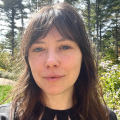
On a winter morning in early 2022, just before dawn, Julia Skonicki slipped out of bed; wrapped herself in layers; called her dog, Rizzo; and stepped out into the woods near the Hyde Park home she shares with her wife. With snowshoes strapped to her feet, she moved through the silence — anxious, sleepless and newly diagnosed with breast cancer.
“I went to the woods to shed fear / To embrace unease and release it,” she later wrote in an untitled poem that appears alongside roughly 70 others in her recently self-published book, Awakened: a journey in poetry and photos. The book chronicles how Skonicki, 44, connected with nature by turning to poetry and photography — always “my preferred avenues for processing,” she said — as a way to navigate her experience with cancer.
At the time of her diagnosis, Skonicki had already spent the previous two years grieving: the deaths of two close friends, then her father, who lived with cancer for the last three years of his life. “I went to the darkest place in my mind,” she said of her own cancer diagnosis. “I really thought I was going to die.”
But morning after morning that winter, she kept going on walks, passing snowdrifts and half-frozen stretches of river, contemplating questions such as What’s my purpose in this world? and If my life is almost over, what can I enjoy and learn while I’m here?
Nature, she said, began to speak back.
“I swear, the universe would present me with answers, no matter what I was going through,” she said. On one morning, when seeking guidance about how her cancer journey was evolving, she recalled that a towering pine offered a quiet reminder — one that became a poetic fragment displayed in her book: “‘Remember,’ said the tree, ‘it’s a long game.'”
Skonicki’s treatment and recovery process unfolded over two years, including two major surgeries, constant medical appointments, and an initial period of shifting diagnoses and second opinions that she referred to as “pretty messy.”
“That really changed my life a lot, being under the microscope for so long,” she said of her experience as a patient. Throughout, she kept walking in the woods, carrying her phone to document what she saw — plants, sunsets and bodies of water. Later, at home, she wrote poems to process what she felt.
Many of those poems explore a gnawing sense of worry and provide reflections on loss and change. An untitled poem written on the last day before beginning a long-term course of Tamoxifen, a hormone therapy often prescribed to breast cancer patients, reads, “Last day without this drug / For the next five to ten years // Last day of no side effects / Last day of fertility / Last day of a natural body / Last day of this chapter.”
Other poems express feelings of gratitude and courage and a newfound awareness of her body:
The Pain is a Gift
Reconnects my soul to my vessel
My heart to my body
My mind to my presence
All of my Being Aligns
Pulsing, Throbbing
Slowly shifting
Striving to reconvene
the complex corporal composition
Initially, Skonicki, who works as the director of development and communications at Lamoille Family Center, didn’t intend to share her poetry or photos. “It was just my personal therapy,” she said. But one day she started posting them to her Instagram page, and the response surprised her.
“People flooded my inbox, saying ‘I can relate to this,’ and ‘I’m so glad you shared,’ and ‘Your vulnerability is helping me be vulnerable,'” she said.
The messages inspired her to compile her poems and images into a book, much of which she did while resting in bed, feeling somewhat healed but still fatigued. At a book launch at Stowe’s Northwood Gallery last month, dozens of people approached her after the reading to share stories of their own hardship, grief and recovery.
In another untitled poem in Awakened, Skonicki writes that her experience with cancer “allows me to seek connection in painful vulnerability.”
“Everyone we know has basically experienced cancer through their own health or through someone else, and it’s something we don’t talk a ton about,” she said.
She’s learned that many people don’t know how — or when — to open up about their pain. “You don’t want to ruin someone’s day when they look like they’re having a good time,” she said. “But for someone like me, that doesn’t ruin it — it makes it better. I love that type of connection. I’m always looking to talk about the hard things.”
This article appears in The Connections Issue.

Got something to say?
Send a letter to the editor and we'll publish your feedback in print!