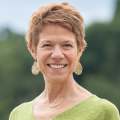
So many times, in the 25 years they’ve lived at Knoll Farm, Helen Whybrow and Peter Forbes have had the somewhat jarring experience of seeing people wandering around right outside their windows. They’ve sacrificed privacy to honor their conviction that a healthy working farm heals people — and that everyone deserves access to it.
The couple’s 167 acres in Fayston include wooded trails, certified organic blueberries, a concert stage and a flock of purebred Icelandic sheep that moves from pasture to pasture. The recently renovated barn, equipped with a commercial kitchen, Oriental rugs, and a hodgepodge of couches and wingback chairs, accommodates retreats, conferences and family celebrations. Overnight guests stay in the retreat village up the hill, which offers a dozen canvas yurts — with skylights that frame the stars — as well as a sauna, a hot tub, and a bathhouse built from clay, straw and sand, crowned with a green roof.
Locals who come to this seasonal destination for pick-your-own blueberries, Sunday yoga or a summer concert may not realize the farm’s greater missions. The first is to foster healthy soil, plants and animals. The second: to offer the farmstead as a place for difficult conversations around justice, land and the environment — and a respite for the people doing that work.
“In addition to being farmers, we are conveners,” Forbes said, “and we believe very, very much in the power of access to land to heal people and to bring people together.”
Acquiring the farm was not a typical real estate transaction. Prior owner Ann Day had given it to the Vermont Land Trust, which required the next stewards to keep it in agriculture and to run educational programs pertaining to land. Whybrow and Forbes had to compete to buy it.
The site, on a hill facing a broad arc of mountains stretched wide like welcoming arms, appeared ideal to the couple. Said Whybrow: “We wanted to farm. We wanted to live on the land, and we wanted to provide a gathering place for people doing justice work.”
The farm operates for profit, earning income from the sale of blueberries, breeding stock, meat and wool. The nonprofit based there, New Learning Journey, runs retreats, concerts and other programs and is funded by individual donors. Between the farm and the nonprofit, Knoll Farm employs eight people year-round and another seven seasonally.
For 12 years, starting in 2003, Forbes, 64, and Whybrow, 58, operated Center for Whole Communities, which invited environmentalists and social justice leaders with differing opinions to meet at the farm to find common ground. Their first retreat brought together loggers and wilderness advocates. Since then, conversations that started around a firepit on the farm have led to the launch of First Light, New Learning Journey’s program that links dozens of conservation organizations with four Wabanaki tribes in Maine to foster shared land stewardship and to return Indigenous land — 52,000 acres so far. Oregon Land Justice Project is the nonprofit’s similar enterprise on the West Coast.
Center for Whole Communities now operates independently in Burlington. And while Knoll Farm hosts retreats for organizations such as the American Civil Liberties Union and environmental nonprofit 350.org, the farm itself has shifted focus from actively facilitating cultural change to nurturing the people doing that work. New Learning Journey hosts weeklong fellowships for people of color and their allies who work for environmental and social causes. The Better Selves Fellowships — 70 of them this summer — cover all expenses, including travel and childcare.
The weeks are lightly programmed because the fellows already know what their work is, Forbes said. “They’re all running these marathons for all kinds of social issues, justice issues — from immigration to police reform to Indigenous rights,” he explained. “These are people who anchor other people — and we’re the place that gives them care and renewal so they can go back and continue running that marathon.”
The farm hosts a similar retreat, called Restoring Force, for people whose work relates to marine conservation in the Northeast and mid-Atlantic.
Offering refuge continues the efforts that Day undertook when she owned Knoll Farm and housed Central Americans fleeing civil war as they made their way to Canada. She taught nearby shopkeepers basic Spanish so they could offer directions to the Bragg Hill Road farm, Forbes said.
Picking up where Day left off “was all a giant leap of faith,” Whybrow wrote in her 2025 Vermont Book Award-winning memoir, The Salt Stones: Seasons of a Shepherd’s Life. She and Forbes weren’t married yet. They had met years earlier, lost touch, then reconnected when she was a book editor and he was working on an anthology about land conservation for his employer, the Trust for Public Land. He hired her to edit and produce the book.
“The anthology,” Whybrow wrote, “marked the first sparks of change in Peter’s career, when he began to publicly question the privileged underpinnings of land conservation and articulate his vision for a broader movement that could no longer shy away from addressing equity, dispossession, and social healing in its work of protecting land.”
Forbes’ dream of a place to do that work materialized when he and Whybrow moved to the farm in 2001. He built tent platforms and outdoor showers and started a nonprofit to run the programs. She brought home chickens and sheep and planted 700 blueberry bushes. On a hillside at sunrise on the summer solstice in 2003, they married. Thirty guests, who had camped there the night before, joined the celebration of their “marriage to one another and to the land,” Whybrow wrote in her book.

Forbes has since taken the lead on the farm’s justice work; Whybrow runs the farm. She and her sister had milked cows and done chores on the small Plainfield, N.H., farm where they grew up, but it was more of a hobby farm, she said. Her father was a doctor and her mother a social worker. She had never tended sheep.
Whybrow’s 100 percent grass-fed flock now numbers about 65, and she mentors other sheep farmers. She aims to have a “closed-loop farm, where the meat that we’re producing is 100 percent generated from the grass and sun and rain of this hillside.”
The sheep eat hay in the winter and graze in the summer. When they’re turned out in the spring, “they get really excited,” she said. “They kick their heels up.”
Rotational grazing benefits the soil and grasses as well as the animals, said Meghan Sheradin, executive director of the Vermont Grass Farmers Association. Eating grass is what sheep are meant to do, Sheradin explained, and grass clipped by a ruminant benefits from the animals’ saliva and breath. The grass feeds the sheep, the sheep fertilize the grass, and healthy grass feeds soil microbes, which, in turn, nourish the grass that feeds the sheep. “So it’s creating the strongest, most resilient system that you can,” Sheradin said.
Knoll Farm employs that system to feed people, literally and emotionally. Well-tended land, part of a healthy ecosystem, becomes a foundation for healthy human communities — those that live and work there as well as those who come for a week or an afternoon, Whybrow said.
Once Amy Paro of Warren saw Knoll Farm, there was no question where she wanted to hold Revive, her three-day restorative retreat for women in early June. “Everything on that farm feels like a warm hug,” she said. Being there is grounding, she explained: It puts people in sync with “the frequency of nature” and provides an opportunity to disconnect from the artificial world and plug into the real one.
Knoll Farm hosts fellowships, concerts and yoga specifically to bring people to the land. “We say that maybe the land is the greatest teacher we have here,” Forbes said, noting that people feel a spirituality on a healthy, working farm. “Indigenous people feel it; white people feel it; rich people feel it; poor people feel it … This place can bring all of those people together.”
Visitors buy blueberries and pay to attend the six concerts, but there’s no charge to come see the sheep or walk the 2.6 miles of trails. Whybrow and Forbes just ask that people check in at the farmstand first to learn if there are retreats or other events they should be respectful of.
Knoll farm doesn’t post “No trespassing” signs. “People should have access to farms,” Whybrow said. “They should see sheep grazing and food growing and be able to pick their own food.”
Six days a week — every day but Monday — a red, white and blue flag flutters at the end of the lane. Its black block letters spell “OPEN.” ➆
Knoll Farm is open to the public Tuesday through Saturday, 8 a.m.-6 p.m., and Sunday, 9 a.m.-3 p.m., through October 15 at 700 Bragg Hill Rd. in Fayston. Dogs are not allowed.
Know Before You Go
- On Blueberry Sundays (July 26, August 2 & 9, 9 a.m.-noon), the farm offers free cinnamon rolls for blueberry pickers, fresh from the wood-fired outdoor oven.
- The farm’s Yoga Sundays (June 28-September 6, 11 a.m.-noon) blend movement and breathwork for all levels. $10-25 suggested donation.
- The 2026 Summer Concert Series features Sky Blue Boys (July 11, 6 p.m.), the Wormdogs (July 18, 6 p.m.), the Wolff Sisters (July 25, 6 p.m.), Cloudbelly (August 1, 6 p.m.), Kathleen Parks Band (August 9, 1 p.m.), and A2VT and Bhangra Liberation Orchestra (August 15, 6 p.m.). Most tickets are by donation; $60 for the August 15 benefit concert for the Better Selves Fellowships; free for children under 12. BYO picnic or purchase a picnic basket.
The original print version of this article was headlined “Grounding Force | Blueberry picking, outdoor concerts, grazing sheep and retreats offer respite at Fayston’s Knoll Farm”


This article appears in Summer Preview • 2026.

Got something to say?
Send a letter to the editor and we'll publish your feedback in print!