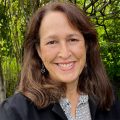
Esther Charlestin had never heard of the Middlebury Selectboard when a friend told her about an opening and suggested she run.
“I was like, ‘Selectboard? What’s that?'” Charlestin recalled. But she was game. She won a seat that had been vacated midterm in 2021 and then was elected to a second term.
That can-do spirit has propelled Charlestin, a political newcomer, into the race for Vermont governor. The diversity and inclusion consultant handily defeated Underhill sailing instructor and substitute teacher Peter Duval in the August Democratic primary, taking 70 percent of the vote. She’s the second Black candidate ever to secure a major party nomination for Vermont governor; Sen. Randy Brock (R-Franklin) was the first when he ran on the GOP line in 2012. He lost to Democrat Peter Shumlin in the general election.
“What I like about Esther is she’s thoughtful, she listens to people carefully, and she’s not afraid to make a decision.” Howard Dean
Former governor Howard Dean is backing Charlestin, after he flirted last spring with the notion of taking on Gov. Phil Scott, a Republican seeking a fifth term. Dean, who also ran for president and chaired the Democratic National Committee, said he concluded that unseating the popular Vermont leader would require an intense, scorched-earth campaign and declined to run.
On October 23, Dean showed up at a press conference Charlestin held at the Statehouse to encourage voters to support her.
“I’m convinced she would be a terrific governor,” he said. “What I like about Esther is she’s thoughtful, she listens to people carefully, and she’s not afraid to make a decision.”
Apart from her stint on the selectboard, Charlestin, 34, hasn’t spent much time around politics or policy but has been pointedly critical of what she sees as Scott’s policy weaknesses.
“Eight years of overpromises and under-delivery” is how she characterized Scott’s work during last week’s press conference. She noted Scott’s record of vetoes — 55 since he took office in 2017 — and his habit of blaming lawmakers for the state’s failure to address critical issues, particularly since the Democrats achieved a veto-proof majority in 2022.
“He refuses to collaborate, and that refusal has hurt Vermonters,” Charlestin said.
Charlestin’s journey to a Montpelier podium began in Bridgeport, Conn., where she was the oldest of five children born to a pair of Haitian immigrants. Her mom works as a nurse’s aide; her dad, who has been diagnosed with schizophrenia, was not a consistent presence when she was growing up.
Charlestin says the source of her political ambition is her mother’s unwavering faith in her.
“I was raised with, ‘You’re made for such a time as this. You’re here for a purpose,'” she said.
At Christian Heritage School in Trumbull, Conn., Charlestin said, she searched for that purpose. Asked if any academic topic had appealed to her, she couldn’t think of one. But when a pastor chose her to deliver a guest sermon, the warm and personable Charlestin discovered she loves public speaking.
Following the tradition of her church culture, Charlestin said, she married at 21 and had two kids, now 7 and 9. She left her husband after eight years of marriage, moving to Middlebury College to take a job as a resident director; it came with housing for her family of three. Her mom lent her a car, and her great-aunt stayed with her for two months to help with the transition. She had worked in a similar role at Bryant University in Rhode Island, she said.
Cast off by church friends who disapproved of divorce, she left her conservative faith and started attending the Unitarian Universalist church.
Charlestin liked her job at Middlebury but found that living in Vermont is tough. Childcare is expensive. Her supporters often emphasize her struggle when comparing her to the relatively affluent Scott, who owned a construction company.
Charlestin lost her housing when she left Middlebury College for a job in a local public school. She couldn’t find an affordable place in Middlebury and landed in Bridport. After serving as dean of climate and culture at Middlebury Union Middle School for a year, Charlestin started her consulting business, working with schools and other organizations on equity and diversity.
At the suggestion of state Sen. Ruth Hardy (D-Addison), Charlestin pursued training in 2022 through Emerge Vermont, a program that recruits and trains Democratic women to run for office. That’s when Charlestin started thinking about taking her public speaking skills to a bigger stage.
Asked what she learned at Emerge, Charlestin mentioned the importance of fundraising and of remembering details. She added that she was moved by a presentation on the late U.S. representative Shirley Chisholm of New York, who in 1968 served as the first Black woman in Congress and later sought the Democratic Party’s presidential nomination.
“I carry that with me all the time,” Charlestin said. “The boldness, the courage.”
Charlestin doesn’t shy away from new experiences. In 2023, she said, an acquaintance in the Vermont Senate invited her to join the board of the Vermont Commission on Women. She hadn’t heard of the group, which advances rights and opportunities for women and girls.
“They said, ‘Hey, this is interesting. You should check it out,'” recalled Charlestin, who was appointed to the 16-member board in January 2023 and is now its chair. “And I was like, ‘Yeah, for sure.'”
These days, Charlestin is fielding queries about her own solutions to the problems plaguing Vermont, including floods, the housing crisis and rising taxes. Her policy proposals are similar to those of Progressives who would like to raise taxes on the wealthy to pay for the crippling costs of education and other public programs. Charlestin favors the 3 percent tax surcharge that was proposed last year on households earning more than $500,000 annually. She also wants to raise property taxes on second-home owners.
Charlestin knows that explaining her policy ideas isn’t her strong suit. Asked during an interview about her goals on the selectboard, she picked up her phone and searched unsuccessfully for an Instagram post from that time.
“I think it was education,” she said.
Pressed for unscripted details on her goals as governor, Charlestin was equally at a loss. If elected, she said, she plans to hire people who can handle the policy work.
“I’m really good at getting experts together,” she said. She has a future chief of staff picked out, though she won’t say who it is.
“She’s super type A organized and really personable,” Charlestin said of the person, whom she described as a Democrat in the Middlebury area. “She’s the one who could say, ‘We need to leverage this federal grant or that program in order to make this happen.’ She knows that stuff.”
Charlestin has remarried and now lives with her husband, Jesse Norford, and two kids in South Burlington, although she said she prefers that people think she lives in Middlebury. That’s the town listed with her name on the Vermont ballot. When she buys a house, she added, she plans to put it in a blind trust so her name won’t appear on public land records. Her kids are in private school.
“I’m a Black woman in a dominant white space,” she said. “For me to act like safety is not an issue, or think that I’m the same as the white men before me, would be a misstep and could lead me to serious danger.”
At the October 23 press conference, Rep. Conor Casey (D-Montpelier) read aloud a statement from Burlington Mayor Emma Mulvaney-Stanak that outlined at length some of Charlestin’s policy positions.
“Esther knows that a healthy economy requires us not to ignore the stagnant nature of wages in our state,” Mulvaney-Stanak said. “Esther supports policies that bolster labor standards and support workers.”
Mulvaney-Stanak noted in her statement that if elected, Charlestin would be Vermont’s first Black governor.
“Electing people who hold marginalized identities, whether it is gender identity, racial identity, or someone from a working-class background, immediately means the individual walks in with a shared experience with the majority of Vermonters,” she said.
In an interview, Dean questioned the scrutiny that Charlestin is facing over her lack of experience. He wondered whether a white male candidate with a similar background would face the same questions, and he noted that Republican governor Deane Davis, who in 1970 passed Vermont’s major land use law, Act 250, hadn’t worked in politics, either.
“If you’re smart and willing to listen to people, you can learn this job pretty quickly,” Dean said. Early in his own administration, Dean related, he relied on the staff of his predecessor, Republican governor Richard Snelling. Snelling died suddenly when Dean, a Democrat, was lieutenant governor. “You have people around you who know the nuts and bolts,” he said.
Some of Charlestin’s supporters have said privately that they don’t think she has much of a chance against the popular governor. Her campaign has raised just $40,000 in donations to Scott’s $300,000, but her backers say they are rallying behind her to send a message. Jim Dandeneau, executive director of the Vermont Democratic Party, acknowledged that it would be tough for any Democrat to defeat Scott.
“The first thing you’ve got to do is convince people the incumbent deserves to lose, and that costs a lot of money and takes a lot of time,” Dandeneau said. “Nobody else stepped up who was willing to take that shot.”
Charlestin is doing so despite skeptical feedback. Her time on the road meeting voters hasn’t been easy on her or on her family, but she wants to “speak for the people.”
“I do believe if we’re not at the table, decisions will be made about us and for us,” she said in an interview. “Whatever sacrifices I have to make to be part of that legacy are important.”
Correction, October 30, 2024: Sen. Randy Brock (R-Franklin) was the first Black person nominated for governor of Vermont by a major party, running on the GOP line in 2012 — a race he lost to Democrat Peter Shumlin. An earlier version of this story contained an error.
The original print version of this article was headlined “The Longest Shot | Democrat Esther Charlestin, a newcomer to state politics, takes on Republican Gov. Phil Scott”
Related Stories


This article appears in Oct 30 – Nov 5, 2024.

Got something to say?
Send a letter to the editor and we'll publish your feedback in print!