Democrats are drafting legislation to raise taxes on Vermont’s most well-to-do, arguing that the 1 percent can afford to pay a little more after benefiting from the recent extension of federal income tax cuts.
Republican Gov. Phil Scott and his legislative allies say that’s a horrible idea and risks deepening Vermont’s financial troubles by driving wealthy residents from the state. Since Democrats no longer enjoy a supermajority in the legislature, Scott’s veto threat could have effectively ended the debate, at least for this year. But it hasn’t.
The House Ways and Means Committee is hammering out a bill that would raise income tax rates for the top 1 percent of taxpayers. Democratic supporters believe it will win them political points even if the effort is killed by Scott’s veto pen.
“We’re asking the folks who have the most in the state to support those who have the least,” Rep. Teddy Waszazak (D-Barre) told Seven Days last week. “It just sort of makes sense to us.”
Top Democrats have been hesitant to pursue the strategy, fearing that Republicans would say they are seeking higher taxes because they don’t have the courage to cut government spending. But earlier this month, some rank-and-file Dems bucked their leaders and made plans to tack two new taxes onto an existing bill.
One would have increased state income taxes by 3 percent on household income over $500,000 a year and by an additional 2 percent on income in excess of $1 million. A second amendment would have imposed higher taxes on some unearned income. Together, the proposals would have raised an estimated $170 million.
After closed-door meetings, House majority leader Rep. Lori Houghton (D-Essex Junction) said she sympathized with the motives behind the initiative but feared it had not been fully vetted. In exchange for the sponsors withdrawing the amendments, leaders agreed to have Ways and Means consider them in a committee bill.
Rep. Mike Mrowicki (D-Putney) noted that record numbers of Vermonters have rallied in “No Kings” events to express opposition to the federal administration and said it was high time lawmakers did the same.
I think we have to recognize that Donald Trump has his thumb on the scale across the country, including in this building, and it’s time we point out who is for the billionaires and who is for working Vermonters.
Rep. Mike Mrowicki (D-Putney)
“I think we have to recognize that Donald Trump has his thumb on the scale across the country, including in this building, and it’s time we point out who is for the billionaires and who is for working Vermonters,” Mrowicki said.
The tax-writing committee has spent much of the past two weeks working on the bill and is still refining its proposal. The current draft would raise taxes on the wealthy in two ways. First, it would raise taxes on the top 1 percent of income earners — those making more than about $586,000 per year.
“Targeting the 1 percenters is very intentional because it is the truly richest people in the state,” Waszazak told Seven Days. “It’s very straightforward.”
The state income tax rate for those high earners is currently 8.75 percent. The bill would increase that to 12.7 percent, raising about $100 million beginning in 2028. An earlier version of the bill proposed raising the tax to 13.3 percent, but that would have tied Vermont with California for the highest marginal tax rate in the nation, which the committee sought to avoid.
The bill would also impose a 4 percent tax on net income from investment income such as capital gains, dividends and rent. That proposal would raise about $48 million, according to fiscal analysts.
The Vermont Chamber of Commerce has pushed back, arguing it could penalize small business owners. In response, the committee has expressed a willingness to narrow this tax further.
The idea of raising taxes on the rich has been around for decades but has gotten greater traction recently in Montpelier. In 2024, the House passed a bill that would have raised the income taxes paid by those making more than $500,000 by 3 percent. The bill died in the Senate.
Things have changed since then with Trump ushering in policies that favor the wealthy while slashing programs for the most vulnerable, said Anika Heilweil. She manages Fair Share for Vermont, a coalition of progressive organizations that pressed for the 2024 bill.
“I think we are seeing quite a bit of political appetite for a tax exclusively on the highest earners,” Heilweil said.
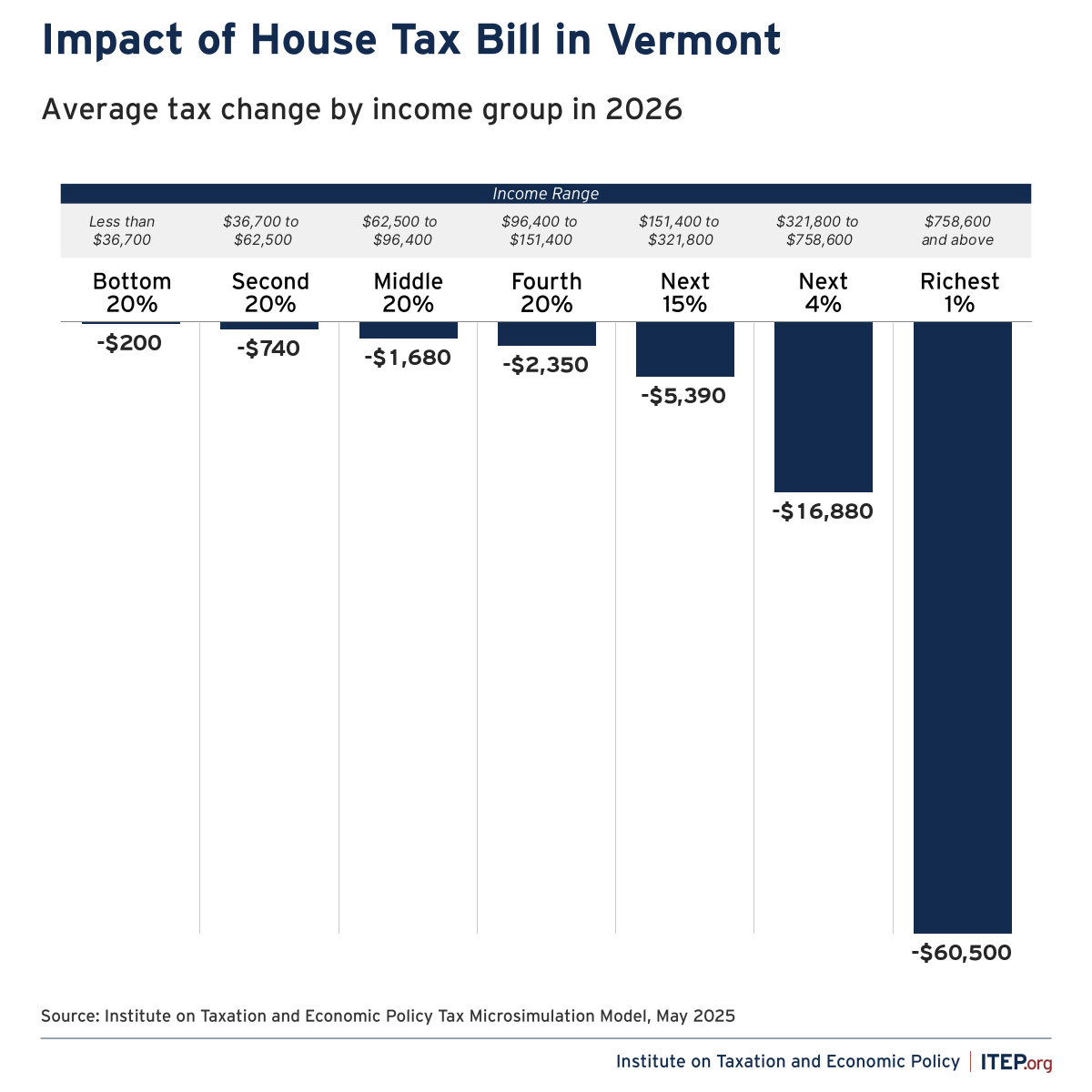
A study by the Institute on Taxation and Economic Policy, a nonpartisan Washington D.C.-based tax policy group, found that the richest 1 percent in Vermont saved on average roughly $57,000 from the 2025 extension of the Trump tax cuts. Under the current version of the Ways and Means bill, Vermont would take back much but not all of those federal tax savings. The wealthiest in the state would still come out ahead, Heilweil said.
Impact of Federal Tax Cuts in Vermont
Average tax change by income group in 2026

She also noted that a recent University of Vermont poll of 542 residents concluded that 80.4 percent of people across all ages, incomes and political affiliations support a tax on the wealthy and corporations. More than 20 wealthy Vermonters, including Ben & Jerry’s cofounder Ben Cohen, signed a letter to lawmakers and Gov. Scott urging them to increase their taxes.
Rep. Emilie Kornheiser (D-Brattleboro), chair of Ways and Means, said wealth tax revenue should go right back to Vermonters. The money could help people pay for health insurance, which is more costly since federal Affordable Care Act subsidies were slashed. The committee is also considering tax credits to help small businesses offset health insurance costs. The funds could also be used to lower the income tax rates for everyone else.

If lawmakers went with the latter scenario, the savings for lower earners would be significant. Those earning less than $84,700 per year could save $135 in income taxes on average, while those making up to $586,000 per year could save $740 per year, according to legislative analysts.
“Right now, I know there are a lot of Vermonters trying to make it work, who are feeling really broke, and we’re going to do everything we can to help them.” Kornheiser said.
But Scott said he is adamantly opposed. While he supports tax cuts for working Vermonters, paying for it by raising taxes on the wealthy is “the wrong approach,” he said last week.
Vermont’s relatively few affluent residents already pay one of the highest tax rates in the nation. Push that rate even higher and they’ll start looking for the exits, Scott claimed. The state would fail to get the promised additional revenue and would also lose out on the substantial tax revenue that wealthy people already provide — as well as significant philanthropy, he argued.
“I’m confident that we’ll take in less than what they think we’ll take in,” Scott said.
That hasn’t been the experience in Massachusetts, which passed a 4 percent income tax surcharge in 2024 and has received higher-than-expected revenue every year since. “We definitely heard that the sky was gonna fall on our heads if we did this,” said Phineas Baxandall, policy director at the Massachusetts Budget & Policy Center, which advocates for progressive causes.
The policy instead has been an “unmitigated success” that pumps more than $3 billion per year into education and transportation initiatives. The warnings of tax flight proved to be overblown, he said.
Cristobal Young, an associate professor at Cornell University, has long studied millionaire taxes. In his book The Myth of Millionaire Flight, Young argues that the idea of “mobile millionaires” fleeing high taxes is not borne out by the facts. Millionaires are more like “embedded elites that are reluctant to move away from places where they’ve been highly successful,” he told the Ways and Means Committee.
“Migration is a young person’s game,” Young told lawmakers. “By the time people are in the top tax bracket, they’re already past the age where they’re thinking about moving around or want to start over in a new place.”
Some do move, of course. His research, which is based on millions of anonymized federal tax returns, has shown that 0.3 percent of millionaires leave high-tax states for lower-tax ones.
That’s “certainly enough to fill an anecdote mill” but far too few to drive state policy, he said.
Scott is unmoved. Asked why he continues to believe what data-based research has shown to be a myth, Scott told reporters that he could “bring in a dozen CPAs who would love to have that discussion with you.”
Tax Commissioner William Shouldice said he had not read the research but dismissed its conclusions as not specific to Vermont. “I think ivory tower idealists fly in the face of commonsense Vermonters,” Shouldice said.
He argues that the wealthy are often business owners whose enterprises keep the economy humming, including by creating jobs for working people. Drive those people out, he said, and the economy will suffer.
“To me, doing anything other than putting out a welcome mat for people of high net worth to come here, to live here, to invest here, I think is sending the absolute wrong message,” he said.
Democrats are keenly aware of Scott’s veto threat. Waszazak is in the camp that believes Democrats ought to pass the legislation regardless, to show they support struggling Vermonters. People forgive elected officials for losing a fight, Waszazak said. “They will not forgive you if you don’t even have the fight.”
It’s not clear that the Senate, where Democrats have a slimmer majority, has the same appetite for a veto battle with the governor. Finance Committee chair Sen. Ann Cummings (D-Washington) said she is undecided. She is open to a “fairer way” to structure the tax brackets but notes that there are only about a thousand millionaires in Vermont and a single billionaire. Raising their taxes just to make a point doesn’t interest her, she said.
I’m not going to tax the rich just for the sake of They’ve got it, and I have the right to take it.
Sen. Ann Cummings (D-Washington)
“I’m not going to tax the rich just for the sake of They’ve got it, and I have the right to take it,” she said.
She also worries that raising taxes on professionals might backfire. For instance, doctors could pass up work in Vermont and head to Dartmouth Hitchcock Medical Center in New Hampshire, a state with no income tax, she noted.
If there were a way to structure new taxes to be revenue neutral, such as by lowering taxes for others, she said she is open to the idea.
All three Republican senators on the committee adamantly oppose such a bill.
“My gut feeling is it’s not worth spending the time to do something that I think would be disastrous for us economically,” Sen. Randy Brock (R-Franklin) said.
Sen. Ruth Hardy (D-Addison) and Sen. Marine Gulick (D-Chittenden-Central) have both expressed support.
Sen. Thomas Chittenden (D-Chittenden-Southeast) is undecided. He said he is open to “recalibrating” the tax code in a way that raises some new revenue from the rich but noted that Vermont’s is already very progressive. He said he believes tax flight is real.
“I’m also a realist. And this isn’t going to come into law,” Chittenden said. “The governor’s going to veto it. So, this is all politics.” ➆
The original print version of this article was headlined “Tax and Defend | Some Democrats say it’s time to raise taxes on Vermont’s richest residents despite Gov. Scott’s veto threat”
This article appears in April 29 • 2026.

Got something to say?
Send a letter to the editor and we'll publish your feedback in print!