


Margot gives it: ★★★½
Remember when Daniel Day-Lewis last announced his retirement from acting, in 2017? Or the time before that? From many celebrities, repeated pronouncements of being done with the profession might sound like a publicity stunt, but from an actor this exacting about his material and craft, they carry weight. Luckily for all of us, Day-Lewis decided to return after all, this time in a film he cowrote with his son Ronan Day-Lewis, who also makes his directorial debut with Anemone.
The deal
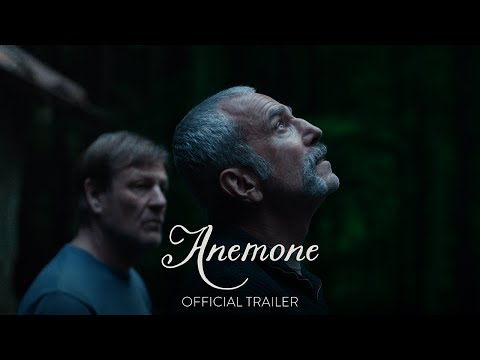
Working-class Jem Stoker (Sean Bean), who lives in the north of England, prepares for a trip to see his estranged brother, Ray (Daniel Day-Lewis), who has spent the past 20 years in hermitic seclusion. Ray forbade Jem to disturb him except in case of emergency. But a situation has arisen that Jem and his wife, Nessa (Samantha Morton), believe merits the term. Nessa’s troubled son, Brian (Samuel Bottomley), has gone AWOL from the army after attacking a fellow soldier for a remark about his family history.
Deep in the woods near the coast, Ray lives in a sturdy hovel with a generator, a woodstove, a crossbow and his vinyl record collection — a bare-bones yet borderline-cozy setup. He and Jem have plenty to say to each other, rehashing the past as they ramble, swim, hunt and drink their way through a couple of days. But Ray becomes angry and evasive when Jem makes it clear what he wants — for Ray to reclaim a responsibility he abandoned long ago.
Will you like it?
Most viewers will come to Anemone expecting electrifying revelations to emerge from Ray and Jem’s conversations, because that’s what the format of two-hander chamber dramas has trained us to anticipate. With cast and context pared down to a minimum, we wait with bated breath for a payoff to the chilling opening sequence, in which the camera pans along a series of increasingly disturbing child’s drawings clearly depicting the Troubles in Northern Ireland. The movie prompts us to wonder how the Stoker men were involved in the violence and what sort of reckoning is approaching.
Though we do eventually get answers, the secrets gradually revealed in Anemone aren’t explosive or original, and the conflict between the brothers doesn’t yield the fireworks we may be expecting. There’s poetry in the screenplay, but it doesn’t lie in the rusty plot mechanics.
Rather, it’s in the rhetorical embroidery and bravado of Ray’s language as he fills in pieces of his past of which his brother wasn’t aware. While calling these monologues “Shakespearean” would be generous, they are well wrought, and Day-Lewis plays them to the hilt. He commands the screen so fully that when Ray soliloquizes, everything else drops away, and Anemone seems to need no raison d’être beyond setting him loose on the material.
Equally poetic are the lush visuals, which keep this minimalist conceit from feeling as if it belongs more on the stage than the screen. Ronan Day-Lewis is also a painter, and the more surreal scenes of Anemone feature mysterious motifs — an apocalyptic storm, an ursine figure — that also appear in his 2024 Hong Kong exhibition “That Summer We All Saw Them.” Director of photography Ben Fordesman (Saint Maud, Love Lies Bleeding) gives the sylvan and seaside landscapes the texture and drama of oil paintings.
Combine these painterly images with Bobby Krlic’s throbbing score and the director’s deliberate, magisterial pacing, and you have the definition of a mood piece. In the symbolically laden world of Anemone, a house might suddenly lose one of its walls to become a glittering jewel box of a diorama against the velvety night. In another scene, a memory literally hovers like a phantom; in others, the blue shades of Brian’s room manifest his psychological state.
The less you focus on what’s actually happening in the movie, the more you sink under its spell. Its visual language speaks eloquently of rage and redemption and the need for ritual catharsis and healing. But if a pesky literalness plagues you, you may find yourself growing impatient with the characters for their seeming inability to work out their differences like normal people.
Anemone ends up feeling like an aesthetically immaculate apologia for being a deadbeat dad. If you catch its vibe, there’s power here, and Ronan Day-Lewis shows clear promise as a filmmaker. As distinguished older thespians ranting and muttering in the wilderness go, Day-Lewis père gives Ralph Fiennes in 28 Years Later a run for his money, and he doesn’t even need a bone palace. Yet one can’t help feeling for Brian and Nessa, who are stuck at home waiting for the patriarch to sort out his head.
If you like this, try…
“Say Nothing” (one season, 2024; Disney+, Hulu): Based on a nonfiction book, this drama series covers four tumultuous decades of the Troubles in Northern Ireland.
Small Things Like These (2024; Disney+, Hulu, rentable): Like Anemone, this acclaimed drama delves into the sins covered up by the church. Cillian Murphy plays a coal merchant investigating his Irish village’s dark history in Tim Mielants’ adaptation of Claire Keegan’s novel.
Phantom Thread (2017; Netflix, rentable): If you missed Day-Lewis’ most recent performance, it could be time to check out this understated, underrated period piece from Paul Thomas Anderson (One Battle After Another) in which the actor plays an exacting dressmaker in midcentury London.
This article appears in Oct 8-14 2025.

Got something to say?
Send a letter to the editor and we'll publish your feedback in print!