

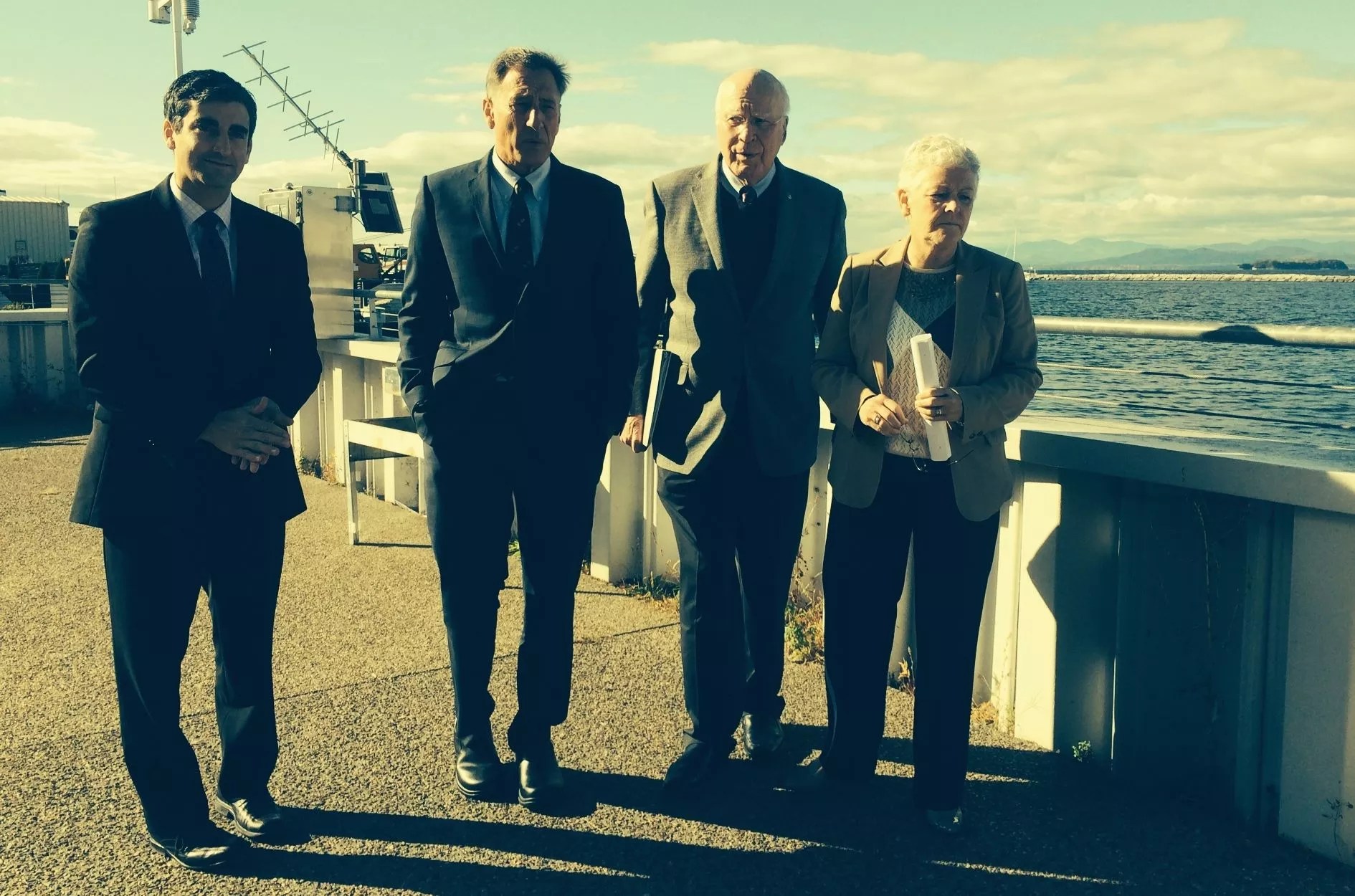
Environmental Protection Agency Administrator Gina McCarthy visited Burlington this morning to unveil a small planning grant to help the city curb pollution runoff into Lake Champlain, and said her agency hopes to make a much bigger lake cleanup announcement in spring.
McCarthy, appearing with Sen. Patrick Leahy (D-Vt.), Gov. Peter Shumlin and Burlington Mayor Miro Weinberger at ECHO Lake Aquarium and Science Center, announced that the city had won a $67,000 grant from her agency to develop plans to reduce Burlington’s impact on the lake. “I’m happy to be able to put a little bit more money into the pot,” McCarthy said. “Work on the ground doesn’t work unless you plan first.”
More significant news about Lake Champlain cleanup is likely several months away. Earlier this year, Shumlin submitted a water-quality plan to the EPA, detailing how the state would reduce runoff into the lake. The EPA rejected the state’s plan in 2011, after the nonprofit Conservation Law Foundation filed a federal lawsuit decrying the lake’s poor water quality. Concern about lake pollution grew this summer when a large algae bloom overran St. Albans Bay.
McCarthy said the EPA is still reviewing the plan and expects to have an answer in the spring. Shumlin said the plan requires a significant federal investment.
“It’s about farms and farm runoff, its about development and development runoff, it’s about roads … ” Shumlin said. “It’s taking the data we have showing us where the most egregious challenges are, and saying, ‘Lets prioritize where the pollution is happening and get change.’ Vermonters will pay up, but we also need the federal government’s help.”
McCarthy acknowledged she was unveiling only a “small grant,” but said she hoped it would renew focus on the need to clean up the nation’s waterways. “We need to bring all the attention that we can to it,” McCarthy said. “I’d like to think the challenge in Lake Champlain is unique. It’s not. We see nutrient blooms threatening waterways across the country.”


Got something to say?
Send a letter to the editor and we'll publish your feedback in print!

More than three weeks have passed since EPA Administrator McCarthy announced the awarding of $67,000 to Burlington for the purposes of, as Seven Days staff writer Mark Davis put it, “…develop[ing] plans to reduce Burlington’s impact on the lake,” – plenty of time to decide how this money will be spent. We realize that its not much in the way of funding (although some highly effective sustainable sanitation and reuse programs have been seeded with far less) but we have to wonder what is being considered. Moreover, how many are aware of the recent RFP:
http://www.burlingtonvt.gov/…/58f2c01d-d956-4cb8-9814-f09ca…
…regarding sludge dewatering.
So, in response to the EPA grant award and in light of the undoubtedly high value of the RFP, can the Burlington community expect to see…
…a widespread education campaign to educate city employees, residents and businesses on the direct role they play in polluting the lake accompanied by the adoption of performance-based codes ensuring that all new or retrofitted homes and businesses must meet zero discharge requirements when it comes to at least the big-tree nutrients (phosphorous, nitrogen and potassium)? Right now, the bulk of these nutrients (at least those not being released during CSO events) are bound up in the sludge that’s collected from Burlington’s three wastewater treatment plants (WWTPs), the total quantity of which is being trucked to upstate New York. There it is being dumped on farmland and, very likely (if not almost assuredly) ending up in surface waters (even quite possibly in Lake Champlain). Some refer to the interstate sludge export program that Burlington is involved in as Chittenden County residents externalizing their costs to low-income people and ecologies located in rural farm country in another state. But if these nutrients are indeed finding their way back into the lake then what’s really going on here? And wouldn’t producing less sludge in the first place be the most cost effective approach to this controversial material?
…an associated pilot project to test the feasibility of promoting and incentivizing residents and businesses to install dry ‘ecological’ toilets in place of, or in parallel with, their flush counterparts? Flush toilets are a major source of the nutrients that find their way into our WWTPs (and into the Lake during CSO events or into the sludge that’s washing into surface bodies of water) and also represent the single highest use of water in the home, roughly about a third of what’s used indoors. What more economical and effective way is there to both reduce nutrient pollution and lower water usage then to stop dumping our excreta into sewers?
…an associated pilot project to test the feasibility of promoting and incentivizing the installation of onsite greywater systems and seasonal and/or year-round onsite rainwater harvesting and storage systems (for limited or unlimited domestic or manufacturing use)? Much of the washwater that a household or business produces can be safely used for onsite irrigation. Onsite greywater systems mimic the natural water cycle by allowing washwater to infiltrate back into the soil and percolate down into the water table, naturally cleaning the water on the way (for free). Likewise, enough water falls annually from the sky over Burlington in the form of rain to provide the majority if not all of the water used in the home or business. Why, then, are we not taking widespread advantage of this free resource? Plus, runoff produced from rain and snow events are another major source of nutrient pollution. So, why then are we not ensuring that water collected by roofs and roadways is kept from entering the lake? Isn’t in far less expensive to engineer our city to allow for the infiltration of rainwater than to pay for the knock-on effects that this stormwater/rainwater/snow-melt exacts on the lake?
…an associated program to promote and incentivize high levels of water conservation, the thought here being to reduce the demand on the city’s antiquated water delivery and wastewater processing systems so that what is delivered and what results from processing (read “effluent”) are of higher quality, thus lowering the costs of maintaining these systems and reducing the associated impacts on the lake? Note: in terms of usage the average US resident uses three times the volume of water used by the average German resident (~150gal/day versus ~50gal/day). Isn’t conservation always the cheaper option? Clearly, at the very least, there’s room here for improvement.
Put simply, can we expect real and lasting solutions to the water quality problems that we face or just more of the same; IOW spinning in circles?