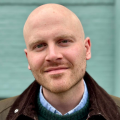
Five days after shooting three young Palestinian men outside his Burlington apartment, Jason Eaton met with two defense attorneys in prison and recounted the chain of events that he claimed led him to open fire on complete strangers.
The attorneys recorded that nearly two-hour conversation on November 30, 2023. On Wednesday, they played brief segments for a packed courtroom as the defense began presenting its case in Eaton’s attempted murder trial.
Eaton, 51, faces a potential sentence of life in prison for the shooting of Hisham Awartani, Kinnan Abdalhamid and Tahseen Ali Ahmad. All three men survived the attack, but Awartani was left partially paralyzed.
The verdict will turn on whether jurors believe Eaton was legally sane at the time of the crime.
The recording was aired during the testimony of Dr. Fabian Saleh, a psychiatrist with John Hopkins Medicine, who testified for the defense that it showed Eaton was clearly psychotic when he shot the men.

“He was operating under the delusional belief that this was a legal, authorized action,” Saleh said. “He didn’t consider his actions to be criminal.”
Prosecutors, whose own expert witness has reached a different conclusion, say Eaton is narcissistic, lacks empathy and feels entitled — none of which justifies his actions.
What Eaton told the attorneys had already been previewed in opening statements. But the recording offers the clearest glimpse yet into his state of mind in the days immediately following the shooting.
On it, he sounds initially cautious, telling the attorneys he’s not sure they have sufficient security clearance to hear what he has to say. But he eventually opens up and walks them through a winding and hard-to-follow narrative that traces the months, weeks and hours leading up to the shooting.
Eaton described how he had come to believe he was watching over a Jewish family in his neighborhood. The month of the shooting, he said, he began receiving messages through FM radio and Bluetooth.
The messages were at first encouraging, praising him for his investigative efforts, he said. But on the night of November 25, 2023, the messages took a dark turn, and urged him to kill by 6 p.m.
He was initially unsure of the intended target, he said. Then, while sitting in a chair near his second-floor apartment window, he saw the three young men in trench coats and traditional Palestinian headscarves known as keffiyehs walking across the street.
The men, who testified earlier this week, said they were speaking a mix of Arabic and English that night, and two were wearing keffiyehs.
Eaton linked the messages to the Israel-Hamas war. He said they mentioned the stalled negotiations between the two sides and how Hamas had not released the Israeli hostages it took weeks before, on October 7.
“This is bigger than you,” he said, quoting the messages.
Eaton said the young men left his line of sight as he prayed over the order to attack them. But, he said, the messages — from the Central Intelligence Agency, God and even his own ancestors — kept urging him to act. Then, in his “mind’s eye,” he saw the young men cross the street, meaning they would soon pass his apartment a second time.
“That’s God showing me that he’s not making a mistake,” Eaton said.
Eaton recalled firing at two men before a misfire forced him to clear a round from the chamber. He said he then shot the third, who was running away.
Eaton told the attorneys he returned to his apartment and waited for agents from the CIA or Mossad — Israel’s intelligence agency — to come kill him.
Federal agents knocked on his door the following morning while looking for witnesses. When Eaton answered, he said something to the effect of, “I’ve been waiting for you,” the agents testified earlier this week.
Speaking to his attorneys just days later, Eaton appeared still to be attempting to make sense of his actions.
“I was either talking to my ancestors and the divine council or talking to an intelligence agency using an incredible AI that could come through my FM radio, through my bluetooth headset, through my phone — or I’ve had this incredible psychotic break,” Eaton said in the recording.
“I’m still confused,” Eaton added. “I still don’t know the answer. Were they innocent victims? Were they planning an attack? [Did I] somehow thwart something?”
The victims and their families have long believed they were targeted because of their identities. But while authorities initially suggested the shooting might be a hate crime, prosecutors were unable to find evidence that Eaton harbored anti-Palestinian views.
Eaton addressed the topic with his attorneys.
“Here’s the good news,” he said in the recording, laughing. “I’ll be amazed if they could prove this is a hate crime. I may have invented the love crime.”
Saleh testified on Wednesday that an untreated psychotic disorder prevented Eaton from recognizing what he did was wrong. The psychiatrist said he based his diagnosis on the 2023 recording, three subsequent interviews with Eaton and a review of medical records.
Prosecutors sought to discredit Saleh’s conclusion by pointing out that it was the first time Eaton had been diagnosed with a psychotic disorder despite repeated encounters with medical professionals over his lifetime.
That included a visit to the University of Vermont Medical Center five days before the shooting, when he was described as logical and optimistic, Chittenden County State’s Attorney Sarah George said.
George further noted that records from the nearly three years Eaton has spent in prison while awaiting trial make no mention of psychotic behavior or delusions. The prosecutor asked Saleh whether he believed an unmedicated person with severe delusions could hide them for that long.
Saleh countered that delusions sometimes surface only when the right questions are asked.
“If I don’t measure your fever with the proper instrument, I can’t just say you’re not feverish,” Saleh said.
Eaton’s sister, Amy Rubright, also testified on Wednesday. She said her brother had struggled with mental health issues throughout his life. She recalled a conversation in December 2021 that worried her.
Eaton, who had struggled to hold jobs for most of his life, was living out of his truck in Syracuse, N.Y., at the time, Rubright said.
He called her out of the blue to say a “veil” had been lifted and he now understood that he was a “light-bearer” whose purpose in life was to help people.
Eaton went on to live with Rubright for a few months not long after that conversation, during which time she said he voiced paranoid thoughts about being followed by the government. But the two eventually fell out of touch and hadn’t spoken for a year before the shooting.
The prosecution’s cross-examination of Saleh will continue on Thursday. Prosecutors will then have their own psychiatrist, who is expected to dispute Saleh’s opinion.

Got something to say?
Send a letter to the editor and we'll publish your feedback in print!